Buying behavior · Field guide
Patterns and friction in B2B purchase decisions
The strongest product may still lose when changing feels more dangerous than staying put. Migration fear, unclear pricing, and committee politics turn apparently rational evaluations into slow, defensive decisions.
8 minute read · United States
Start with the cost of changing
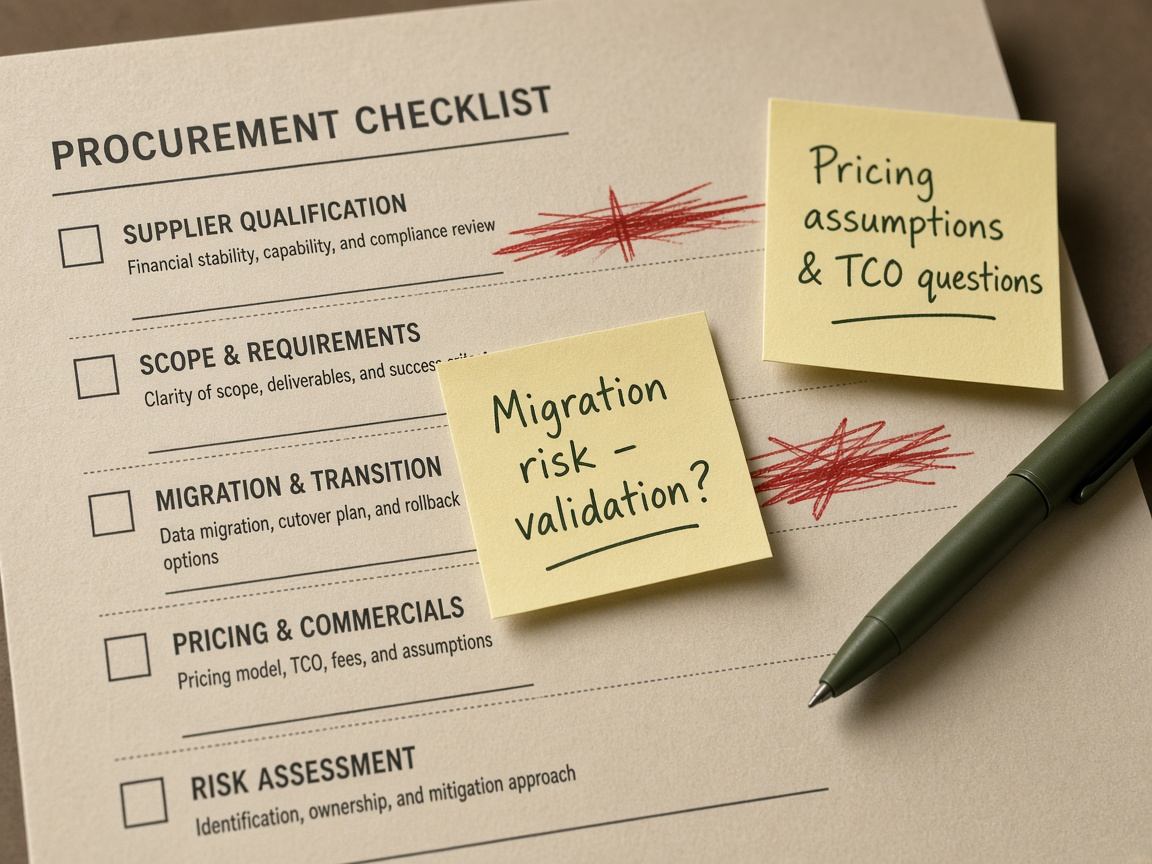
Buyers rarely compare software on features alone. They compare a known operating system with an uncertain transition. A finance team considering a move from QuickBooks may understand the benefits of another platform and still hesitate because historical records, integrations, tax workflows, and staff habits must survive the move. Search behavior around “quickbooks migration” often expresses risk before it expresses aspiration.
Researchers should ask what must remain uninterrupted, who would be blamed if it failed, and what proof would make the transition feel reversible. Those questions reveal a practical risk model. For stronger prompts, use the customer interview guide.
Pricing opacity multiplies uncertainty
Complex pricing is not automatically bad; unexplained pricing is. Buyers need to anticipate seats, implementation, support, storage, add-ons, and future tiers. If a vendor hides important assumptions until a sales call, the committee begins building its own worst-case estimate. That unofficial estimate can become more influential than the proposal.
When buyers compare a candidate with QuickBooks, the useful research question is not simply whether one price is lower. Ask which costs can be forecast, which require negotiation, and which might appear after adoption. Capture the buyer’s exact language, then map the moments where confidence drops through touchpoint mapping.
Committee politics shape the shortlist
A buying committee is not one persona multiplied. The daily user may want speed, IT may prioritize control, procurement may want predictable terms, and the economic buyer may need a defensible reason to approve disruption. A proposal can satisfy each criterion separately yet fail because nobody has a safe internal story for alignment.
Look for veto power, private reservations, and the person doing unpaid consensus work. Interview people in distinct roles rather than asking one sponsor to speak for everyone. The decision-maker research framework helps separate influence from formal authority.
Timing also changes the political landscape. A budget deadline may accelerate approval while a busy close period makes even a favorable option feel impossible. Record the events surrounding each decision rather than treating the sales cycle as a simple count of days. The same committee can behave differently when a contract renewal, leadership change, audit, or integration failure alters the cost of waiting.
When synthesizing findings, distinguish a solvable information gap from structural resistance. A clearer migration plan can reduce uncertainty; it cannot create an implementation owner where none exists. This distinction keeps marketing from promising that one case study or calculator will remove every barrier.
Comparison grid
What buyers say, and what to investigate
“Migration looks hard”
Identify protected workflows, feared data loss, timing constraints, and the proof required from implementation.
“We need a real price”
Document the full cost model, assumptions, expansion triggers, and what the committee must explain internally.
“The team is not ready”
Find the hidden veto, competing incentives, implementation owner, and personal consequences of a failed choice.
Turn friction into an evidence plan
Do not answer every hesitation with more persuasion. Observe the buying journey, test the language, and make claims proportionate to what buyers actually revealed.
Explore research methods